
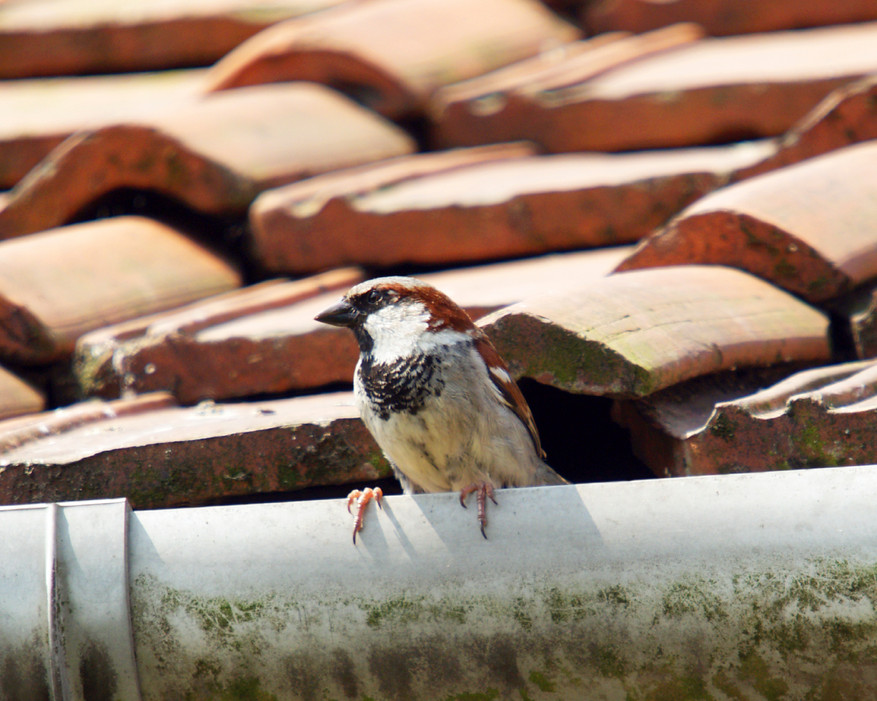
Are House Sparrows Invading to Your House This Spring?
House sparrows (Passer domesticus) are aggressive birds that are very abundant. Where there are houses and buildings, there will be sparrows, and they are one of the most common birds found around the home. You might get so used to seeing them around that you do not realize they are pest birds and should be deterred. They are aggressive and more often than not displace native birds from nest boxes. It is hard to overlook the house sparrow when they are the number one adversary of the bluebird and purple martin; bird lovers who try and entice native species into their yards are often disappointed by the nuisance house sparrow. In fact, the house sparrow has been observed threatening and attacking over 70 species that come within its nesting territory. If you are interested in experiencing bluebirds in your yard, you will need to be very serious about house sparrow control.
Property and Garden Damage
The damage the house sparrow causes is another reason to implement bird control to keep them away. They damage gardens by eating seeds, buds, flowers, and young vegetation such as peas and lettuce, and they harm cherry, peach, and pear trees as well.
More detrimental than the health of the garden is the health of the family. House sparrow droppings create contaminated, hazardous, and odoriferous situations around walkways and structures, anywhere under their perching, roosting, and nesting areas. If they are allowed to build nests, their acidic droppings can damage paint, block gutters, and create fire hazards by nesting around electrical units, dryer vents, and even power lines. Sparrows and other pest birds can also carry and spread many human and livestock diseases and internal parasites, including fleas, lice, mites, and ticks. While other pest birds may also carry these, the house sparrow is more likely to transmit them due to its sheer abundance.
Humane Deterrents for Sparrows
Bird netting can be applied to fruit trees and gardens as a low-profile means of deterring pest sparrows from roosting or nesting. The netting blends in with plants and is basically invisible, acting as a lightweight physical barrier that blocks birds from a specified area. It can also be used in garages, sheds, balconies, and eaves; wherever a nook or cranny needs protection, bird netting can be installed and secured using a staple gun or bird netting clips.
Another low-profile and easy-to-implement bird deterrent for sparrows is bird gel. Transparent and non-toxic, bird gel creates a sticky, uncomfortable surface that sparrows and most other birds dislike, giving them no choice but to fly on past. It can be used on any ledge, under eaves, on windowsills, or on any vertical surface where pest sparrows perch and roost. Using integrated bird control with both bird netting and transparent bird gel will guard against perching, roosting, and nesting at the same time.
For larger areas where pest sparrows are a nuisance—such as a large backyard with lots of ground where sparrows are seen in droves picking at seed—an outdoor sound device would be very advantageous. Sonic outdoor sound devices are designed to deter pest birds from large open spaces and can be programmed to play sparrow distress and predator calls. These calls alert birds to danger, triggering their natural fight-or-flight instinct so they fly away from the area.
Bird deterrents do not have to be destructive to the bird or property. Bird control methods can blend into the environment and safely get rid of pest birds.