
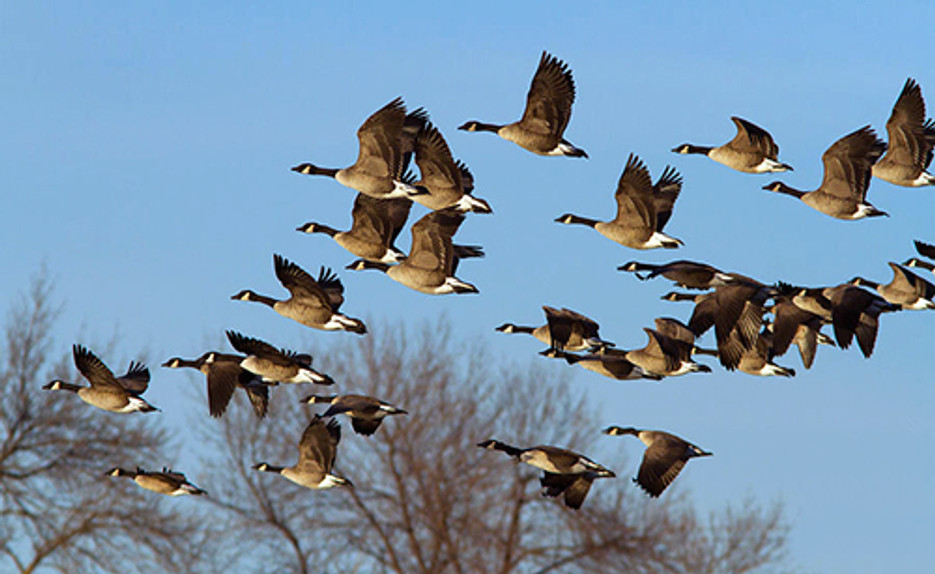
Get Ready – The Geese are Coming
When you think of Canada geese, you probably envision birds with a distinctive black head and neck, light cream or tan breast, brown back, and white chinstrap. There are over 10 subspecies of Canada geese, and according to the Cornell Lab of Ornithology, there has been a significant increase of these birds in urban and suburban areas in recent years. Spring and summer are when geese concentrate their feeding, grazing on hedges and grasses while gravitating toward land with water sources like golf courses and public parks. For more guidance on managing these populations, be sure to check out our guides on how to prepare for the Canada goose migration and making peace with Canadian geese.
Territorial Behavior and Public Safety
Spring is the season when pairs break free from larger flocks and begin aggressively defending their territories. Geese have been known to chase children and adults alike, which can be alarming in populated public areas. Threat displays from Canada geese often involve head pumping, hissing, and honking. They will frequently fight one another, and injuries can occasionally occur when humans or pets get too close.
The Health Hazards of Goose Droppings
Along with nuisance behaviors in populated places, goose droppings create a major health hazard. A single goose defecates every twenty minutes, adding up to 1.5 pounds of feces per day—meaning a flock can quickly create an overwhelming mess. Goose feces contain a wide range of pathogens capable of infecting humans, including the microscopic parasite Cryptosporidium, which is one of the most common causes of waterborne contamination in both drinking and recreational water sources.
Effective Prevention with Migrate Goose Repellent
Getting ready for goose season does not need to be expensive or time-consuming. Migrate Goose Repellent is an excellent choice for golf courses, parks, cemeteries, residential yards, and shorelines. This non-toxic goose deterrent is sprayed onto the area using a standard handheld sprayer. For best results, apply it when the turf is freshly mowed and dry, avoiding freezing temperatures or the hottest hours of the day. A second application should follow one week later. Rain, mist, and sprinklers will not wash off the repellent, and it leaves no environmentally harmful run-off.
How Methyl Anthranilate Works
The active ingredient in Migrate is Methyl Anthranilate—a non-toxic, EPA-registered grape extract that safely irritates the birds' trigeminal nerves and mucous membranes. It has proven highly effective at driving geese and other pest birds away from treated areas. It is always best to apply the repellent *before* geese begin to nest so they do not return to protect eggs and raise young.
Application and Coverage
One gallon of concentrate treats approximately 16,000 square feet when mixed at a ratio of 20 parts water to 1 part concentrate. Available in single one-gallon bottles or cases of four, it remains one of the most cost-effective bird control products on the market. Golfers and parkgoers won't even realize treatment has occurred, as Methyl Anthranilate is completely safe for humans and domestic animals while successfully keeping the property free of geese.